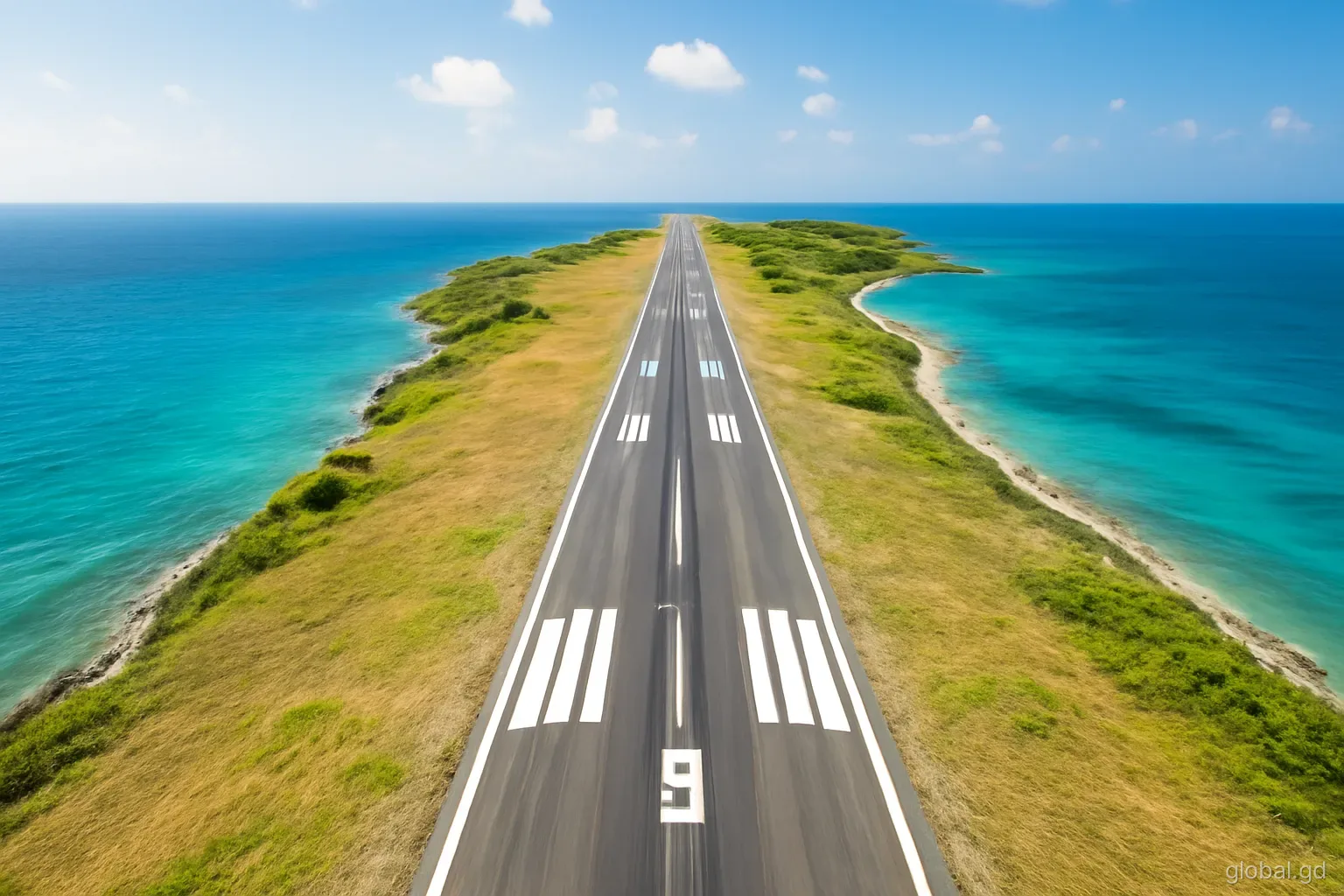
Every international flight into Grenada lands on a single strip of tarmac at Point Salines, on the dry south-western tip of the island. That runway, at Maurice Bishop International Airport (code GND), is long enough for wide-body jets from London and North America to arrive non-stop. It is easy to take for granted. For most of the twentieth century Grenada had nothing of the kind, and the story of how it got one runs straight through the most turbulent years of its modern history.
For anyone thinking about Grenada as a place to invest, base a business or settle, the airport is more than a piece of transport infrastructure. It decides how many seats reach the island, which cities are a single flight away, and how exposed the economy is to decisions made in airline offices in Miami, New York, London and Toronto. This explainer traces the path from Pearls to Point Salines and what it means for the island's connections today.
Pearls: the airport that held Grenada back
Before Point Salines, Grenada's airport was at Pearls, on the Atlantic coast of St Andrew near Grenville. It was a short runway hemmed in by hills and sea, and it could not take the jet aircraft that were transforming Caribbean tourism from the 1960s onwards. Visitors from Europe and North America typically flew into Barbados or Trinidad and then changed to a smaller propeller aircraft for the last leg, which added time, cost and uncertainty to every journey.
Location made things worse. Pearls sits on the far side of the island from St George's and the south-west, where hotels were clustering around Grand Anse. Arriving passengers faced a long drive over the central mountains through Grand Etang before reaching their beds. Night operations were limited, and the approach was demanding in poor weather.
Islands with jet-capable airports pulled ahead in visitor numbers while Grenada stayed dependent on connecting flights. The idea of a new international airport on the flat land at Point Salines had been discussed for years by successive administrations, but the cost was far beyond what a small state could fund alone, and the project kept stalling.
Building Point Salines in a Cold War spotlight
Construction finally began under the People's Revolutionary Government, which took power in 1979. Cuba supplied workers, equipment and technical support, and funding and materials also came from a range of other governments and institutions. To the Grenadian government it was a long-overdue piece of development infrastructure that would open the island to mass tourism.
The United States saw it differently. Officials in Washington argued publicly that a runway of that length on a small island could serve Soviet or Cuban military purposes, and the airport became one of the most cited points in the dispute between the two governments. Grenadian officials and many outside observers pointed out that other Caribbean islands had similar runways for tourism.
The revolution collapsed in violence in October 1983, followed within days by the US-led military intervention. The airport was still unfinished. Work continued afterwards, with American and other international funding, and Point Salines International Airport opened in 1984. In 2009 it was renamed Maurice Bishop International Airport, after the revolutionary-era prime minister killed in 1983, a decision that reflected how the project had become part of national memory.
What the runway made possible
Non-stop long-haul flights. With a runway of roughly 2,700 metres, Point Salines can handle the wide-body aircraft that British Airways (from Gatwick) and Virgin Atlantic (from Heathrow) use on their London services, some of which call at St Lucia or Barbados on the way. Without that length, Grenada would still depend on changes in Barbados or Antigua for transatlantic travel.
Direct North American links. Narrow-body jets from New York, Miami, Atlanta, Toronto and seasonal cities such as Charlotte reach Grenada without a stop. Even a flight of five hours is routine for the runway.
A south-west tourism belt. The airport sits minutes from Grand Anse, Morne Rouge, True Blue and Lance aux Epines. That proximity pulled hotel, villa and resort investment into the south-west and helped make the corridor between the airport and St George's the commercial heart of the island.
Room for growth. Terminal facilities, aprons and services have been upgraded at various points since 1984. The physical constraint on Grenada's air connectivity is now less the runway than the willingness of airlines to commit aircraft to the route.
A medical-school economy. St. George's University, with its campus at True Blue beside the airport, depends on students and faculty flying in from North America and elsewhere. Easy air access underpins one of the island's largest private employers.
Who runs the airports today
Maurice Bishop International Airport is operated by the Grenada Airports Authority, a statutory body that also runs Lauriston Airport on Carriacou. Lauriston has a short runway suitable only for small propeller aircraft, which link Carriacou with the main island and, at times, with neighbouring islands in the Grenadines. Pearls is no longer used for commercial flights.
Airlines decide routes, frequencies and fares themselves. The government's influence works through the Grenada Tourism Authority, which promotes the destination and negotiates marketing arrangements with carriers, and through airport charges and taxes, which feed into the cost of every ticket. Airport development projects, from terminal works to runway resurfacing, are typically financed with support from regional and international lenders.
For a business or a household relying on the airport, the practical point is that GND handles international departures and arrivals reliably for its size, but it is a single runway with a single terminal. Weather systems, a closed runway or an aircraft fault can cut the island off for hours, and there is no second international airport to divert to within Grenada.
How Point Salines compares with its neighbours
Grenada was not the only Eastern Caribbean state to wait a long time for a jet runway. St Vincent and the Grenadines opened Argyle International Airport only in 2017, after decades of relying on a short strip at E.T. Joshua that could not take long-haul jets. Dominica still has no airport capable of handling large jets. Against that backdrop, Grenada's jet runway of 1984 gave it a head start of more than thirty years over some of its neighbours.
Barbados, Antigua and St Lucia, by contrast, had jet-capable airports earlier and built their tourism industries around them. They remain the larger hubs, with more daily long-haul flights, and Grenada still relies on them for many connections. The practical effect is a two-tier system: Grenada has enough runway to receive non-stop flights from the main markets, but it has fewer of them, and travellers from secondary cities usually connect somewhere.
For someone comparing islands as a base, this is a useful lens. A destination's infrastructure tells you what is possible; its schedule tells you what airlines currently believe the market will support. Both have changed over time and will change again.
What the history means for investors and residents
The airport's story leaves several lessons that still apply to anyone tying their plans to Grenada's connectivity:
- Air access is a policy outcome, not a given. Grenada waited decades for a jet runway. Route networks can shrink as well as grow, as the collapse of the regional airline LIAT in 2020 showed.
- Location follows the runway. Property, hotel and office demand has concentrated in the south-west because the airport is there. Areas far from Point Salines, such as Sauteurs or the Atlantic coast, trade lower prices for longer transfers.
- The island depends on a handful of carriers. A decision by one airline to cut a route affects seat supply noticeably. Diversified plans, such as being comfortable connecting via Barbados or Trinidad, reduce the risk.
- Carriacou is a separate access question. Lauriston and the inter-island ferry are its links, and both have limits worth understanding before buying or building there.
- History is part of the place. The name on the terminal is a reminder that the revolution and 1983 remain live topics. Visitors and newcomers do well to listen before offering opinions.
Frequently asked questions
Why is Grenada's airport named after Maurice Bishop?
Maurice Bishop led the People's Revolutionary Government, under which construction of the Point Salines airport began in 1979. He was killed in October 1983. The airport opened in 1984 as Point Salines International and was renamed in his honour in 2009, recognising his role in starting the project.
Is Pearls Airport still in use?
No. Pearls, near Grenville in St Andrew, has not handled commercial flights since Point Salines opened in 1984. Its short runway could not take jet aircraft. The old site is largely disused, and all international traffic now goes through Maurice Bishop International Airport in the south-west.
Can large wide-body aircraft land in Grenada?
Yes. The runway at Point Salines is roughly 2,700 metres long, enough for the wide-body aircraft used on the London routes. Very long non-stop flights with heavy loads can face performance limits on any runway of this length, but current scheduled services operate routinely.
Does Carriacou have its own airport?
Yes. Lauriston Airport on Carriacou is run by the Grenada Airports Authority. Its short runway takes only small propeller aircraft, mainly on flights to and from the main island. Most people and almost all freight reach Carriacou by sea from St George's.
How far is the airport from St George's?
Maurice Bishop International sits on Point Salines, roughly ten kilometres from the centre of St George's. Depending on traffic, the drive usually takes around twenty to thirty minutes. Grand Anse, True Blue and Lance aux Epines are closer, often within ten to fifteen minutes.